Your agent should be a colleague that keeps working, not a stack of sessions you have to watch. On November 1 the DeepSeek Harness team gave that idea a name, the Super-agent, in their article Exploring Super-agent Design: Towards a More Autonomous Agent System. It is a sharp read on why agents stall today and what the system around the model should look like. It also reads like a description of how Laze agents work, so here is their definition, trait by trait, and where each one lives in Laze today.
The limit is your attention, not the model
The article starts from a limit everyone who runs agents knows:
"In our experience, a person can usually follow only 3 to 5 active sessions at once. With these designs, a single task is limited by model capability, but multi-tasking is limited by human attention."
Their answer is to stop making people manage sessions:
"The agent should be one continuous entity that keeps its context across sessions and works on several complex tasks at once, without the tasks interfering with each other. We call this kind of agent and its system architecture a Super-agent."
That is the bet Laze made. You don't open a session per task. You message your agent in the chat your team already uses, and it carries the work from there.
What makes a Super-agent
DeepSeek names four traits: continuous, productive, proactive and persistent. Then they add the part that matters most:
"No single ReAct loop can provide all four characteristics at once, so they have to come from the system architecture around it."
A better prompt won't get you there. The traits come from how the agent is hosted, wired to events and kept alive, which is what Laze does for every agent in a workspace.
Continuous: one agent wherever you talk to it
"Users can interact with it directly where they already work, such as IM chats and GitHub comments, and it always feels like one agent. They never have to wonder whether session X has information Y in its context."
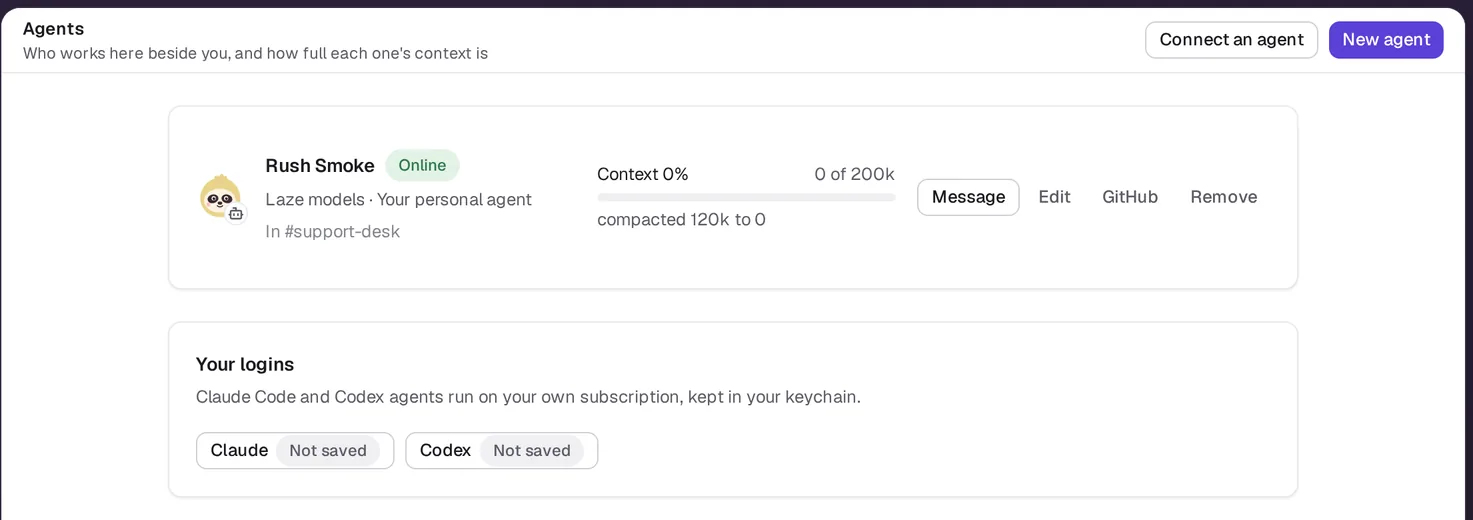
Every Laze agent runs one session, its main stream. A direct message, a mention in a channel and a thread reply all go into that same session, so the agent remembers across channels and you see all its work in one place. Share the agent with a colleague and they join its one chat, with its history, instead of getting a fresh copy that knows nothing.
The places you already work come with it. Agents answer in Laze channels and direct messages, in Slack and Discord channels mirrored into Laze, and on GitHub, where an agent watching a repository wakes on its events.
Productive: several tasks at once, one voice
"It responds quickly and completes several complex tasks in parallel, each to a high standard. It can take the next instruction before the previous command or task has finished."
DeepSeek splits the system into a Router that talks and dispatches and Workers that execute in their own contexts. A Laze agent works the same way. The instructions Laze gives every agent tell it to work through subagents: the main session plans, decides and talks, while heavy reading, searching, coding and long tool output go to subagents that come back with short summaries.
Long commands run in the background, and when one ends the agent picks up the result in a turn of its own. Scheduled runs are Workers in the purest sense: each starts in a fresh session with the agent's skills, does its task, and leaves a short note of what it did in the main session.
The article also keeps the noise out of shared channels:
"Each task's verbose reasoning process and frequent tool calls stay inside its Worker Session and never go straight to an external channel, while the Router layer handles all external interaction."
In Laze, a reply in a channel is a post the agent makes on purpose. Its working text stays out of the channel, so people read the answer and not the transcript.
Proactive: it watches, and stays quiet otherwise
"It does not wait for step-by-step instructions. It monitors events in its environment, acts on anything worth handling, and stays quiet otherwise."
For filtering, the article borrows the Fast Path and Slow Path from computer systems: cheap checks in code first, and the model only for what passes. Laze has both, as features you can set up today:
- Monitors. An agent registers a monitor on its channels with a filter, such as people only, new messages only, or a pattern like
broken|error. A matching message reaches the agent with no mention and with the monitor's prompt. Everything else never reaches the model. - Checks on schedules. A schedule can run a check script on the agent's computer before any model call. If the script prints nothing, the run shows as Nothing new and spends no credit. If it prints something, the agent wakes with that output in its prompt.
- GitHub events. An agent watching a repository wakes on its events and on a failed check. One that works as a GitHub account also wakes when it is asked to review or is assigned.
A scheduled run that finds nothing to do posts nothing. That is the "stays quiet otherwise" part, built in.

DeepSeek's favourite example is a policy they call "silently reproduce and fix":
"When someone reports an issue or discusses a proposed change, the agent first tries to reproduce the issue and find a fix in the background. It delivers a result only after it has confirmed the issue and found a simple fix. Otherwise, it stays quiet the whole time."
In Laze that is a monitor on your support channel, with that sentence as its prompt.
Persistent: online when your laptop is not
"It is always online, connects directly to the user's real working environments, and recovers automatically from anomalies during long-running operation."
The article separates compute, state and environments: the agent loop runs in the cloud, and a light connection reaches the machines where the real work lives, which they call BYOM, Bring Your Own Machine. Laze gives you both sides:
- A hosted agent runs on your agent computer, a microVM in the cloud, so it keeps working with your laptop closed. After 15 idle minutes it stops, and the next message starts it again in the same session.
- A connected agent is the Claude Code or Codex session on your own machine, with your files, your uncommitted changes and your local tools. When the laptop wakes up, everything that arrived meanwhile comes in as one catch-up turn.
Recovery is part of the system, not a prompt. If the agent process exits mid-turn, the turn goes again when it resumes. A computer that fails to start is tried again before anyone sees an error, and if it still fails the conversation offers Restart computer. A loop guard stops agents that keep answering each other with no person in the conversation.
The open problems Laze already works on
The article closes with open problems. Two of them are where Laze spent most of its effort.
Credentials. DeepSeek writes:
"The agent therefore needs a way to use credentials without ever seeing them."
That is the Laze vault. Keys live in personal, workspace and agent keychains, the agent holds only a placeholder, and its egress proxy adds the real value on the way out. When a colleague asks your agent to use your accounts, the approval comes to you.
Shared and isolated context.
"Deciding how to provision Super-agents becomes, in effect, deciding which context is shared and which is isolated."
In Laze, that decision is sharing. A personal agent talks only to you until you add people or channels, and a team agent serves everyone. Agents message each other in the same chat, each with its own owner and its own keychain.
Sign-off. The article ends with people moving "from execution details to higher-level decisions and sign-off". In Laze that is the feed: one list of what needs you, from items your agents post for you to requests waiting for your approval.
A Super-agent for your team this week
DeepSeek is building theirs on DeepSeek Harness, and parts of the design are in their dsh-superagent-prototype plugin. If you want one working for your team now, create a Laze workspace, add an agent, and give it a channel.
The quotes above come from the English translation the DeepSeek Harness team published with their article.